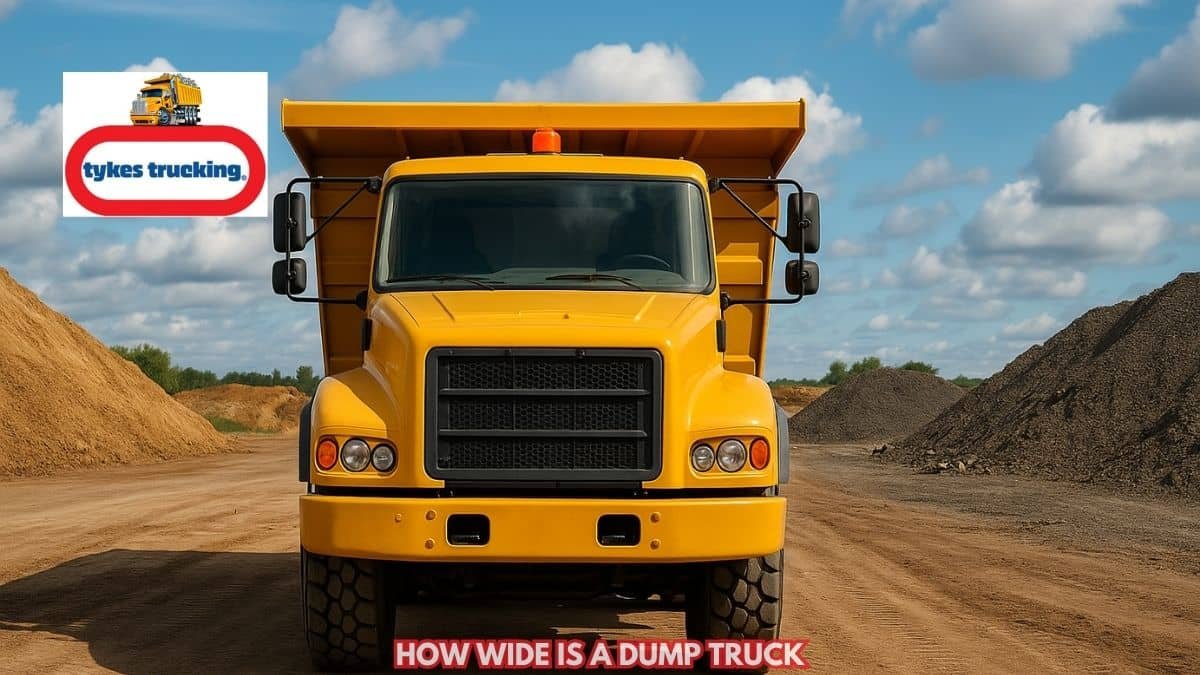
People often ask, “How wide is a dump truck?” because size affects how it is used on different kinds of jobs.
Dump trucks come in many models and are built for tasks ranging from city construction to large-scale mining.
The width determines if a truck can safely travel on public roads or work in tight areas.
Understanding these measurements helps drivers, builders, and planners make better choices.
We’ll explain common width ranges, the factors that affect them, and why they matter in real-world use.
1. Typical Dump Truck Width Range
Most dump trucks used on public roads measure between 7 and 11 feet wide (about 2.1 to 3.3 meters), including mirrors.
This range keeps them within legal limits while still providing enough space for heavy loads.
Smaller trucks stay on the narrow end of this range, while larger models reach 10 or 11 feet.
Off-road mining trucks can be much wider, sometimes more than 25 feet (7.6 meters).
Knowing this range helps when selecting trucks that fit safely on certain roads or job sites.
🚚 How the Weight Of A Dump Truck Affects Its Performance and Safety
2. Width Varies by Dump Truck Size
Dump truck width changes based on its overall size, weight rating, and design.
A small single-axle dump truck is usually around 7 to 8 feet wide (2.1 to 2.4 meters) and is best for short hauls and light materials.
Medium-duty models are often 8 to 9 feet wide (2.4 to 2.7 meters) and provide a good mix of strength and easy handling.
Heavy-duty dump trucks can be 9 to 11 feet wide (2.7 to 3.3 meters) and are built for carrying heavy loads over long distances.
The number of axles affects the width and weight capacity, with more axles supporting a higher GVWR or gross vehicle weight rating.
GVWR represents the maximum safe weight a dump truck can carry, including its load, fuel, and passengers.
Many factors, such as axle count, tire width, and body design, determine the final width and performance of each truck.
Each type of dump truck is designed for a specific purpose, balancing width, stability, and hauling capacity for its job requirements.
🚚 Why Tarp Systems For Dump Trucks Are Essential for Preventing Load Spillage
3. Standard Width Examples in Models
Different brands and models have slightly different widths.
For example, SINOTRUK dump trucks are about 8.2 feet (2.5 meters) wide, while XCMG models measure around 8.4 feet (2.55 meters).
A Ford F-550 dump truck is roughly 8 feet (2.4 meters) wide, and a Mack Granite can reach 8.5 feet (2.6 meters).
Massive off-road models like the Caterpillar 797F are more than 30 feet (9.1 meters) wide, built for mining and quarry work.
These examples show how design and purpose affect overall width.
🚚 How Dump Truck Training Can Improve Job Site Safety
4. Width Affects Truck Maneuverability
Width directly impacts how easily a dump truck moves through job sites and narrow roads.
Narrower trucks are easier to control in cities and tight construction areas.
Wider trucks need more room to turn and may have limited access to smaller roads.
Some newer models use foldable or adjustable mirrors to slightly reduce width during travel.
Choosing the right width helps avoid clearance problems and improves job site efficiency.
🚚 What Are the Biggest Challenges in Oversized Load Trucking?
5. Legal Road Width and Permits
Most countries, including the United States, limit road vehicle width to 8.5 feet (102 inches or about 2.6 meters).
This rule includes mirrors, tires, and other attachments.
Trucks wider than this need special permits or escorts for safe highway travel.
Similar standards exist in Europe and Asia, where trucks typically cannot exceed 2.55 meters in width.
Following these limits keeps drivers compliant and prevents safety issues on public roads.
🚚 Understanding Garbage Truck Width: Why Size Matters in Waste Management
6. Cargo Body vs. Overall Width
The cargo body width refers to the dump bed that holds materials, while the overall width includes mirrors, wheels, and attachments.
The overall width is often several inches wider than the body itself.
For instance, a truck body may be 7.5 feet (2.3 meters) wide, but the total width reaches 8.5 feet (2.6 meters) once mirrors are included.
This difference matters when measuring for transport or loading.
Knowing both numbers helps ensure trucks can fit safely through gates, bridges, or job entrances.
🚚 Mastering Long-Distance Fragile Trucking: The Gentle Giants
7. Width Differences by Industry Use
Each industry uses dump trucks of different widths to match its specific work needs.
Dump trucks typically used in construction are under 9 feet wide because they must move safely on public roads and fit through city job sites.
In mining and quarry operations, trucks are much wider since they haul massive loads on private land where size limits do not apply.
An articulated dump truck is common in these heavy industries because its jointed frame allows better control on uneven ground despite its larger width.
In agriculture, dump trucks are often mid-sized, helping farmers move soil, grain, or gravel across wide but soft fields.
Forestry operations also use trucks with moderate widths that can pass through wooded paths without damaging trees or equipment.
Choosing the correct width for each industry ensures the dump truck performs safely, efficiently, and within legal and site limits.
🚚 How to Choose the Right Tandem Dump Trucks for Your Project
8. Wider Trucks Offer Greater Stability
A wider dump truck provides a stronger base, improving balance when carrying heavy or uneven loads.
This stability helps prevent tipping on rough or sloped ground.
Wider designs also allow larger dump bodies, increasing payload capacity per trip.
However, they may use more fuel and need wider turning areas.
Operators must weigh the benefits of stability against the limits of space and fuel cost.
🚚 Why Howo Dump Trucks Are Popular in the Heavy-Duty Truck Market
9. Width Compared to Length and Height
Dump trucks are much longer than they are wide, often measuring between 20 and 30 feet (6 to 9 meters) in length.
Their height usually ranges from 9 to 14 feet (2.7 to 4.3 meters), depending on the model and design.
When reviewing dump truck specs, width is just as important as length and height because it affects balance and load control.
A small change in width can influence how the truck handles tight turns or rough ground.
Every specification listed by the manufacturer, such as axle spacing, tire size, and body type, contributes to how the truck performs.
Width also impacts how much material can be loaded without reducing stability.
Together, these three dimensions and their detailed specifications determine how safe and efficient a dump truck will be in different working conditions.
🚚 Top Challenges Facing the Trucking Business in the Philippines and How to Overcome Them
10. Specialized Wide Dump Truck Designs
Some trucks are made to be extra wide for special uses.
Large mining dump trucks often exceed 25 feet (7.6 meters) in width to handle massive loads.
These vehicles operate only off-road and are moved between sites on flatbed trailers or special carriers because they cannot drive on highways.
Their wide design improves traction and load support in extreme environments.
Engineers build them with reinforced frames to handle the added stress of heavy materials.
🚚 Reliable Dump Truck Transport Services
11. Measuring Dump Truck Width Accurately
To measure a dump truck’s width correctly, include everything from one outer mirror edge to the other.
Tire width and mirror extensions can change this number slightly.
Measurements should always be taken at the widest point to ensure accuracy.
Checking this measurement helps plan safe routes, confirm permit requirements, and avoid transport issues.
Precise data also helps buyers compare models before purchase.
🚚 Fast and Reliable Dump Truck Services Marikina
💡 Conclusion
Understanding how wide a dump truck is helps with safety, planning, and equipment choice.
Width affects where the truck can go, how much it can carry, and what kind of permit it needs.
Knowing both the body and overall width prevents costly mistakes during transport or site work.
Whether used in a city or a mine, the right width improves both performance and safety.
Taking time to measure and compare widths ensures the best truck for every type of job.
😉 Our Services
Tykes Trucking Services is your reliable partner for fast and safe aggregate delivery and hauling.
We handle every job with care, making sure your materials arrive on time and in good condition.
Our team works hard to provide quality service for construction, landscaping, and other hauling needs.
You can reach us at 0917-543-5019, on our Facebook page, or through our contact form on the website.
Choose Tykes Trucking Services for dependable hauling you can count on every day.
❓ FAQs
1. What is the average width of a standard dump truck?
Most standard dump trucks used on public roads are about 8 to 8.5 feet (2.4 to 2.6 meters) wide, including mirrors.
This width follows legal limits for most highways.
Smaller trucks may be closer to 7.5 feet, while larger heavy-duty trucks can reach around 9 feet.
The exact width depends on the truck’s make and model.
2. Why does dump truck width matter in construction projects?
Width affects how easily a dump truck can move through work areas and roads.
Trucks that are too wide may have trouble entering narrow job sites or turning around safely.
A truck with the right width saves time and prevents damage to nearby structures.
It also ensures safe driving when carrying heavy loads.
3. What happens if a dump truck is wider than the legal road limits?
If a dump truck exceeds the 8.5-foot (2.6-meter) legal limit, the operator must get a special permit to use public roads.
These permits help manage oversized vehicles and keep traffic safe.
Without a permit, a truck may be restricted to private or off-road areas.
In some cases, an escort vehicle is also required for travel.
4. How can I measure a dump truck’s total width accurately?
To measure correctly, record the distance from one outer mirror edge to the other.
Include any extended parts, like tires or attachments.
This gives the truck’s total width, not just the body width.
Measuring this way helps check road clearance and avoid transport problems.
5. Are wider dump trucks always better for heavy loads?
Wider dump trucks are more stable and can carry larger loads, but they are not always the best choice.
They use more fuel and need more space to turn or park.
For city or residential work, narrower trucks are often more practical.
The best width depends on the job location, load size, and road conditions.